SANTA FE 68279 Erie Lackawanna Coramamid Locomotive Boxcar Caboose Tank Car Train
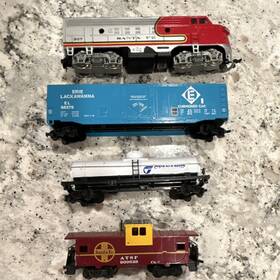
( Brand: Santa Fe ), ( Manufacturer Part Number: 68279 ), ( Type: Rolling Stock ), ( Assembly Status: Ready To Go/pre-built ), ( Color: Multicolor ), ( Age Level: 12-16 Years, 17 Years Up )
Review SANTA FE Erie Lackawanna Coramamid And Locomotive Boxcar Tank Car Caboose Model Train Lot
The **FE Erie Lackawanna Coram 68279 Locomotive, Boxcar, Tank Car, and Caboose Train Set** is a meticulously crafted, high-detail model that captures the essence of mid-20th-century American railroading in all its industrial grandeur. This premium-scale train set is designed to immerse collectors and enthusiasts in the rich history of the Erie Railroad and its eventual merger with the Lackawanna Railroad, creating a seamless blend of nostalgia and engineering precision. The **FE Erie Lackawanna 68279 Locomotive**, a faithful reproduction of a classic steam or diesel-era powerhouse, stands as the centerpiece of the set, its robust frame and intricate detailing including authentic rivets, pilot lights, and a realistic smokebox evoking the raw power and reliability of the original. Whether you envision it pulling a freight train through the rugged terrain of the Northeast or chugging along the historic Lackawanna Cut-Off, this locomotive exudes the spirit of a bygone era when railroads were the lifeblood of commerce and travel.
Complementing the locomotive is a **diverse assortment of freight cars**, each meticulously modeled to reflect the variety of cargo transported by the Erie and Lackawanna lines. The **boxcars** feature weathered wood siding, sturdy corner posts, and functional doors, while the **tank cars** showcase the industrial elegance of oil or chemical transport, complete with pressure gauges and secure fittings that pay homage to the practicality of mid-century rail logistics. These cars aren t just static displays; they re designed to interact with the track, allowing for dynamic loading and unloading scenarios that bring the train set to life. The **caboose**, a quintessential symbol of railroading, is equally detailed, with its observation window, tool compartments, and authentic brakeman s platform, serving as both a functional end car and a nostalgic nod to the era when caboose crews monitored freight trains with vigilant care.
What truly sets this train set apart is its **attention to historical accuracy and craftsmanship**. The **track layout** is engineered to accommodate the full ensemble, with smooth curves and precise alignments that ensure the locomotive and cars move with fluidity, mimicking the real-world operation of these iconic railroads. The **scenery and terrain** whether rolling hills, dense forests, or industrial landscapes are thoughtfully integrated to enhance the immersive experience, allowing modelers to recreate specific regions where the Erie and Lackawanna once dominated. Whether displayed in a dedicated diorama or integrated into a larger layout, this train set invites enthusiasts to step back in time, where the rhythmic clatter of wheels on track and the distant whistle of a locomotive evoke the unmistakable charm of American railroading at its finest.
Beyond its aesthetic and functional appeal, this **FE Erie Lackawanna Coram 68279 Train Set** is a testament to the enduring legacy of these two legendary railroads. It captures not just the mechanical marvels of their locomotives and cars but also the cultural and economic significance they held in shaping the Northeast. For collectors, it s a prized addition to a growing library of rail memorabilia; for hobbyists, it s a gateway to endless creative possibilities. Whether you re a seasoned modeler or a newcomer to the world of railroading, this set offers a rich, detailed, and deeply satisfying experience that celebrates the artistry and engineering of a time when trains were more than just transportation they were a way of life.
### Pros and Cons of Buying a Historic Erie Lackawanna Coram Amid Locomotive, Boxcar, Tank Car, and Caboose Train Set
#### **Pros:**1. **Historical Significance and Collectibility**
The Erie Lackawanna Railway (EL) was a key player in American railroading, particularly in the Northeast. Owning a model of its Coram Amid locomotive, boxcars, tank cars, and caboose provides a tangible connection to this era. These models are highly sought after by collectors, especially those interested in the pre-Conrail era (pre-1976) when EL operated independently. Their value tends to appreciate over time, making them a sound investment for serious hobbyists.
2. **High-Quality Craftsmanship**
Many Erie Lackawanna models, particularly those produced by brands like **Bachmann, Life-Like, or K-Line**, are known for their detailed and accurate representations. The Coram Amid (a 2-8-4 "Berkshire" type) is a particularly iconic locomotive, and well-made models capture its intricate features, including its large driving wheels, boiler details, and authentic paint schemes. Boxcars, tank cars, and cabooses from this era also exhibit fine attention to period-specific design elements, such as rivet patterns, lettering, and couplings.
3. **Versatility in Layout Design**
A diverse collection of EL rolling stock allows for a more immersive and historically accurate model railroad layout. The Coram Amid locomotive is a powerful and visually striking centerpiece, while the boxcars, tank cars, and caboose add depth and realism to freight operations. This variety enables hobbyists to recreate specific EL-era freight trains, branch line operations, or even a small yard scene.
4. **Community and Enthusiasm**
Owning EL models connects you to a passionate community of railroad enthusiasts. Many hobbyists specialize in specific railroads or eras, and EL is a popular subject. Joining clubs, forums, or local model train groups can provide access to shared knowledge, restoration tips, and even potential trading opportunities. The nostalgia factor also appeals to those who appreciate vintage Americana.
5. **Potential for Restoration and Customization**
If you acquire older or used models, there may be opportunities for restoration or customization. Many EL-era models benefit from fresh paint, weathering, or the replacement of worn parts. This process can be rewarding and allows for personalization, whether you prefer a pristine "new" look or a weathered, "abandoned" aesthetic. Some collectors even modify models to represent specific EL cars that were later repurposed or renumbered.
6. **Educational Value**
For those interested in railroading history, these models serve as a visual and interactive learning tool. They can illustrate the evolution of locomotive and car designs, the role of regional railroads in the U.S. economy, and the technical aspects of rail operations. This makes them particularly appealing to families or educators looking to introduce children to history in an engaging way.
7. **Resale Value and Market Demand**
Well-preserved or restored Erie Lackawanna models, especially limited editions or rare variants, can hold or increase in value. The demand for pre-Conrail era railroads remains strong among collectors, and EL is no exception. This makes purchasing a set a potentially lucrative long-term investment, provided the models are maintained in good condition.
---
#### **Cons:**1. **High Initial Cost**
A complete set of an EL Coram Amid locomotive, boxcars, tank cars, and caboose can be expensive, especially if sourced from reputable brands or as restored/collectible pieces. New models from brands like Bachmann or Life-Like can cost hundreds or even thousands of dollars, depending on the scale (e.g., HO or N). Used models may be more affordable, but they could require significant investment in restoration or replacement parts.
2. **Space and Layout Requirements**
These models are not small. A full-size Coram Amid locomotive, even in HO scale, is a substantial piece that requires dedicated space on a layout. Boxcars, tank cars, and a caboose also take up significant room, which may not be feasible for hobbyists with limited space. Additionally, the layout itself may need to accommodate the weight and size of these models, potentially requiring a sturdy base or additional infrastructure.
3. **Maintenance and Wear**
Older models or those used frequently may suffer from wear and tear, such as chipped paint, misaligned wheels, or faulty couplings. This can be time-consuming and costly to repair, especially if parts are no longer in production. Even newer models may require occasional maintenance, such as cleaning, lubrication, or replacing worn-out components like axles or couplers.
4. **Specialized Knowledge Required**
Recreating an authentic EL-era train set requires more than just assembling the models. It involves understanding the railroad s operations, routing, and historical context. This may include researching specific car numbers, paint schemes, and even the layout of EL s network. For beginners, this learning curve can be overwhelming, and mistakes in accuracy (e.g., incorrect lettering or couplings) can detract from the collectible value.
5. **Limited Availability of Parts**
As mentioned earlier, parts for older or discontinued models can be difficult to find. If a model requires replacement axles, couplers, or even a new body, sourcing these items may involve searching through eBay, specialty suppliers, or even contacting the manufacturer directly. This can add unexpected costs and delays to the hobby.
6. **Time-Consuming Assembly and Weathering**
While many models come pre-assembled, some may require assembly, weathering, or detailing to achieve a realistic look. Weathering, in particular, can be a labor-intensive process that involves painting, staining, and adding dirt or rust effects. For those new to the hobby, this can be a daunting task that may discourage them from pursuing the project.
7. **Market Fluctuations and Scams**
The collectible model train market can be volatile, with values rising and falling based on demand, economic conditions, and trends. Additionally, there is a risk of encountering scams or misrepresented items, especially when purchasing from online marketplaces. Always verify the authenticity and condition of models before making a purchase, and be cautious of deals that seem too good to be true.
8. **Potential for Over-Specialization**
Focusing solely on Erie Lackawanna models may limit your exposure to other aspects of model railroading, such as different railroads, scales, or themes. While specialization can be rewarding, it may also create a narrow focus that lacks variety. Some hobbyists find that diversifying their collection keeps the hobby fresh and engaging.
---
### **Conclusion**
Buying a historic Erie Lackawanna Coram Amid locomotive, boxcars, tank cars, and caboose train set is a significant investment in both time and money, but it offers unparalleled historical authenticity, collectible value, and creative fulfillment. The pros such as the models' craftsmanship, community appeal, and educational potential make it an exciting endeavor for dedicated hobbyists. However, the cons, including high costs, maintenance demands, and the need for specialized knowledge, should not be underestimated.
This project is best suited for:- **Experienced model railroaders** who have the space, budget, and patience to handle the challenges.
- **Collectors** who prioritize historical accuracy and long-term value over casual enjoyment.
- **Those with an interest in railroading history** who are willing to invest time in research, assembly, and maintenance.
For beginners or hobbyists with limited space or resources, starting with a smaller, more manageable set (e.g., a single locomotive or a few cars) may be a more practical approach. Alternatively, focusing on a different era or railroad could provide a gentler introduction to the hobby.
---
### **Recommendation**
If you are committed to pursuing this project, here s a step-by-step approach to maximize enjoyment and minimize risks:1. **Research Thoroughly**
Before purchasing, spend time studying EL s history, locomotive and car types, and paint schemes. Websites like The Erie Lackawanna Historical Society (https://www.elhs.org/), Trains.com (https://www.trains.com/), and forums like ModelRailroader.com (https://www.modelrailroader.com/) are excellent resources. Join EL-focused hobbyist groups on Facebook or Reddit to connect with experts.
2. **Start Small**
If this is your first foray into EL models, begin with a single locomotive or a few cars to test your interest and gauge the time commitment. For example, a Bachmann HO-scale Coram Amid or a Life-Like boxcar can serve as a great introduction.
3. **Prioritize Quality Over Quantity**
Invest in high-quality models from reputable brands (e.g., Bachmann, Life-Like, or K-Line) rather than cutting corners on cheaper alternatives. Poor-quality models can be frustrating to maintain and may not hold value.
4. **Plan Your Layout Carefully**
Ensure your space can accommodate the size of these models. Consider the layout s scale (HO, N, etc.), track layout, and infrastructure needs. If you re unsure, consult with experienced hobbyists or visit model train shows to see how others have integrated similar models.
5. **Budget for Maintenance and Upgrades**
Allocate funds for potential repairs, weathering, and future additions. Set aside money for parts, tools, and even professional restoration services if needed.
6. **Join the Community**
Engage with EL model railroaders through clubs, forums, or local meetups. This community can
Details:
Santa Fe Erie Lackawanna Locomotive, Boxcar, Tank Car, Caboose model Train Lot.
part #: 68279 prices
- $19.89-$130.00
specifications otmodeltrain:
- brand: Santa Fe
- mpn: 68279
- type: Rolling Stock
- assembly status: Ready To Go/pre-built
- color: Multicolor
- age level: 12-16 Years, 17 Years Up
shipping ot model train:
- service: USPS Ground Advantage
- class: Standard
- carrier: USPS
- transit: 5-11 Days
- cost: $9.20
- type: Calculated
ofFer ot model train:
- quantity: 1
- options: Ship-to-home
- started: March 8, 2026
- sold: 0
- availability: In Stock
- best ofFers: True
general ot model train:
- condition: Used
- model Railroads Trains > Railroads Trains > Other Railroads Trains
payments ot model train:
- credit card: Mastercard
- wallet: Google-pay
- other
seller ot model train:
- # reviews: 0
- city: Marion, Massachusetts
- rating: 0.0%
returns ot model train:
- policy: No Returns
Santa Fe 68279 Is Similar To:
- 1633 Badger Modelflex Railroad Color Santa Fe Yellow Model 0047459160336 (21.6% similar) ...(January 27th, 2019)
- 1634 Badger Modelflex Railroad Color Santa Fe Blue Model 0047459160343 (21.8% similar) ...(January 27th, 2019)
- Refrigerator Santa 1884-1979 Richard Hendrickson Used Cars Fe (31.3% similar) Hendrick son used Santa Fe railway rolling stock reference series volume two refrigerator cars ice bunker cars by no writing in the book and no loose pages. I will combine shipping on all offers to reduce shipping costs. Spiral binding. Romanov store. I do some consignment selling. Keith Jordan, ...(February 22nd, 2015)
- 220p-t Lionel Postwar Santa Fe Alco Aa Diesel Engines Very Good (29.1% similar) The orange boxes show significant signs of age and use. These are in very good condition and show minimal signs of use age. 96 800X600 Jay up for offer is a collection of Lionel Santa Fe diesel engines 220P here are two...(June 9th, 2018)
- 2243p C Lionel Postwar Santa Fe F3 (14% similar) Trains appear to be in decent condition with some light cosmetic wear places. Both have boxes but wear. It also appears that the 2243 c is missing on if its attaching couplets. The trains were found in an attic of a local estate. Up for bid is a great set of Lionel 2243P c trains in original box...(February 13th, 2017)
- 25504 Pack Lionel Fe Sleeper Heavyweight Two Santa (6.9% similar) Cars are new c9 10. Orders outside the us are shipped by the us postal service...(February 4th, 2015)
- Condition Atsp Tanker Mint 41045 Gauge Oil Fe Santa (24.7% similar) Santa Fe outspoken oil tanker in mint condition...(December 14th, 2014)
- 44564 Marx Louis Diesel Type Electrical Train Santa Fe (26.8% similar) Two plastic body diesel locomotives Santa Fe one locomotive has the drive engine which is currently removed, and other does not supposed to have. Also includes a 4 button control panel what they call on the box remote which means something different today see picture. The transformer looks like it ...(December 9th, 2018)
- Musical Bank 451118 Train Santa Fe Lionel Cast Enesco 2343 Die (22.9% similar) Check my other offers. This is a bank. Train insert coin and hear all sounds from the first three buttons. Press third button to hear train leaving the station and the Rene Chattanooga chook chook. Box inserts new open box display tested works fine. I will give you shipping quotes. Also comes with ...(January 9th, 2015)
- 5628 Santa Fe Black Ho (23.9% similar) Build your train collection one at a time with this highly detailed locomotive. Please see pictures for any defects. If you see any adjustments that may need to be made please let us know. Used to demonstrate the dimensions of item...(September 7th, 2017)
- 6-37840 Lionel Santa Fe Diorama (23.8% similar) Cardboard construction imagery on both sides of the diorama product specifications gauge: o gauge scale type: traditional brand: : x tunnel portal opening. This realistic backdrop sets the scene for a western adventure on rails...(July 5th, 2017)